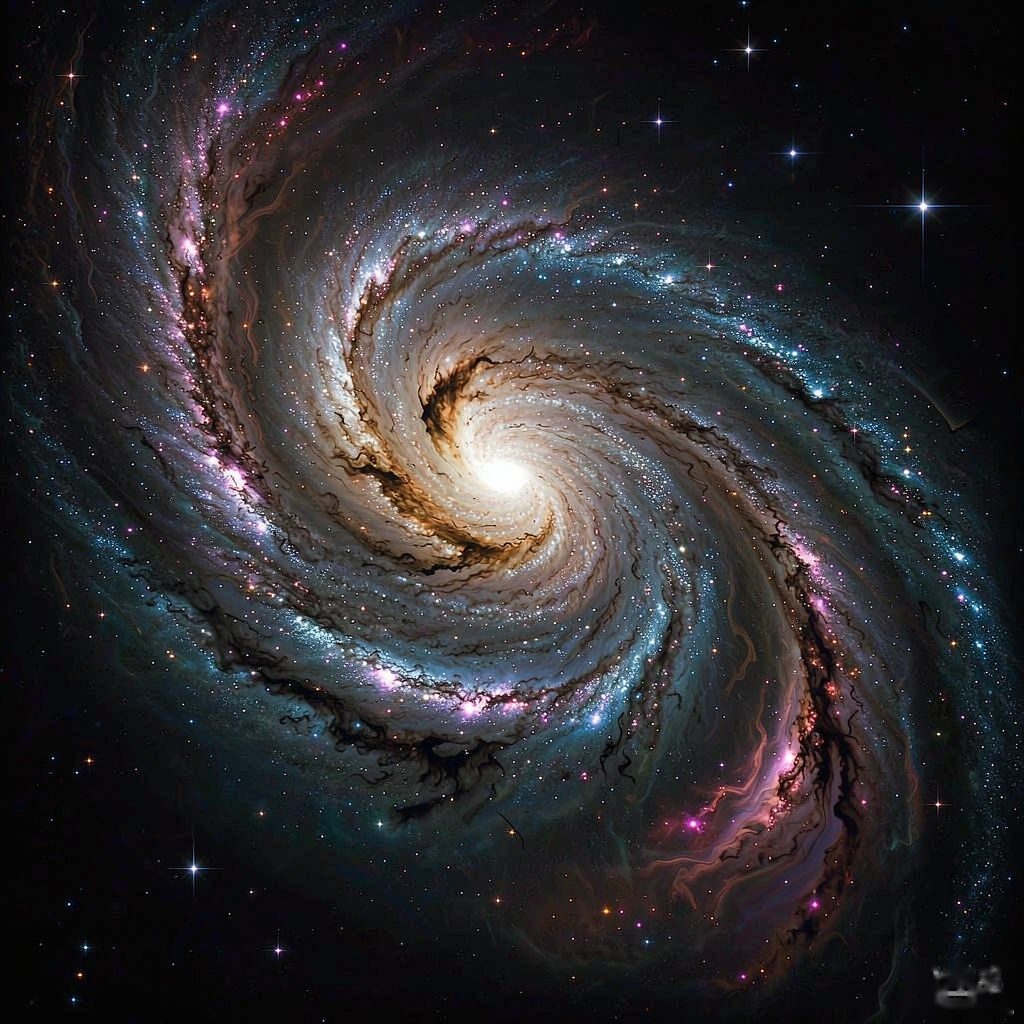
The universe is 13.8 billion years old and holds more than two trillion galaxies. This is a field guide written for everyone — no physics background required, only curiosity.
Modern cosmology tells us that everything — matter, energy, space, and time — emerged about 13.8 billion years ago from an extremely hot, dense state expanding at incredible speed: the Big Bang. It was not an explosion at a point in space, but the expansion of space itself, like raisins all moving apart as bread rises. Some 380,000 years later the universe cooled enough for atoms to form, and light streamed freely for the first time — that "oldest light" still fills the sky as the cosmic microwave background, discovered by accident in 1965. The first stars ignited a few hundred million years later; our solar system formed 9 billion years after the Bang.
How do we know the universe expands? In 1929 Edwin Hubble found that light from distant galaxies is redshifted — they are all receding, and the farther they are, the faster they flee. Rewind the film and everything once shared a point. In 1998, distant supernovae revealed the expansion is accelerating, driven by "dark energy." Invisible dark matter and dark energy make up 95% of the cosmos — ordinary matter, everything you have ever seen or touched, is just 5%.
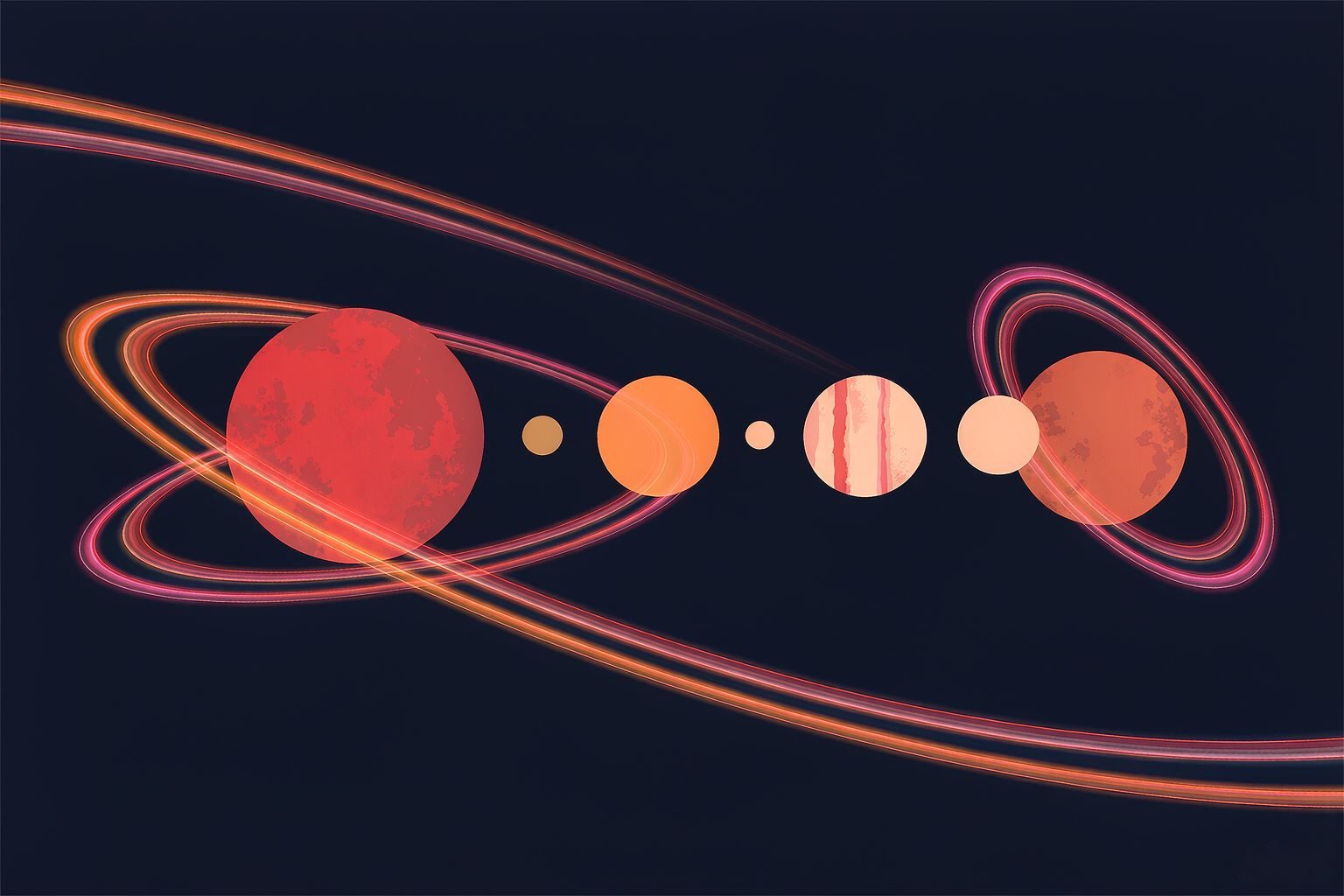
4.6 billion years ago a cloud of gas collapsed into a spinning disk; the center ignited into the Sun, and leftover dust accreted into planets. Each world has its own character:
| Planet | Distance | Claim to fame | In one sentence |
|---|---|---|---|
| Mercury | 0.39 AU | Smallest | No atmosphere; a 600°C swing between day and night. |
| Venus | 0.72 AU | Hottest | A runaway greenhouse at 465°C beneath sulfuric clouds. |
| Earth | 1 AU | Our home | 71% ocean, shielded by a magnetic field and ozone layer. |
| Mars | 1.52 AU | Next stop | Home of the tallest volcano (21 km) and ancient riverbeds. |
| Jupiter | 5.2 AU | King of planets | 2.5× the mass of all other planets; a storm older than nations. |
| Saturn | 9.5 AU | Ringmaster | Rings of ice, 270,000 km wide yet ~10 meters thick. |
| Uranus | 19.2 AU | Sideways | Tipped on its side, likely by an ancient collision. |
| Neptune | 30 AU | Windy | Storms reaching 2,100 km/h — the fastest winds known. |
The Sun holds 99.86% of the system's mass, fusing 600 million tons of hydrogen every second; its light takes tens of thousands of years to fight to the surface, then 8 minutes 20 seconds to reach us. Around it: dwarf planet Pluto, hundreds of moons (the buried oceans of Europa and Enceladus are prime targets in the search for life), millions of asteroids, and countless comets — fossils of our system's birth.
Stars are the universe's great factories. Each begins as a cold molecular cloud: gravity compresses it until, at roughly 10 million degrees, hydrogen fusion ignites. A star spends its life balancing radiation pressure against gravity; our Sun is mid-career, stable for another five billion years.
Mass decides destiny. Sun-like stars swell into red giants (possibly swallowing Earth's orbit), shed their outer layers as planetary nebulae, and leave behind white dwarfs — Earth-sized, teaspoon-heavy. Stars above eight solar masses die spectacularly: fusion runs to iron, the core collapses in under a second, and the star detonates as a supernova as bright as its whole galaxy. The iron in your blood and calcium in your bones were forged in such blasts. The most massive cores collapse into neutron stars — a teaspoon weighs a billion tons — or black holes.
We are made of star-stuff. — Carl Sagan
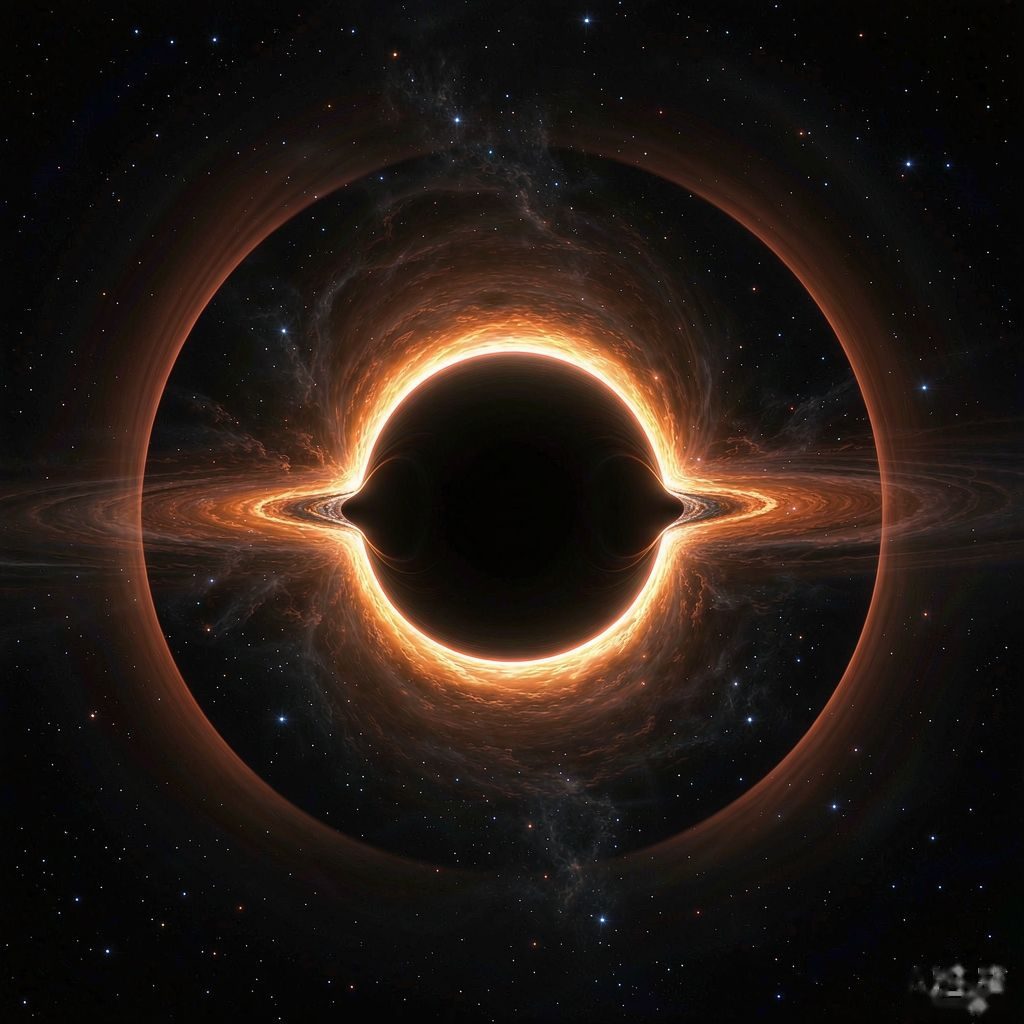
A black hole is a region where gravity is so strong that not even light escapes. It is not a cosmic vacuum cleaner — only what crosses the event horizon is lost; orbiting bodies pass safely by. In 2019 the Event Horizon Telescope revealed the first image of a black hole: M87's giant, 6.5 billion solar masses. Our own galaxy hosts Sagittarius A*, four million suns' worth of darkness at the center.
Near a black hole, spacetime warps so deeply that time visibly slows — gravitational time dilation, real physics, not movie magic. Infalling matter forms accretion disks heated to millions of degrees, which is the glow we photograph. In theory black holes evaporate via Hawking radiation — a stellar-mass hole would take 10⁶⁷ years, far longer than the universe has existed.
A galaxy is a colossal collection of stars. The Milky Way holds 100–400 billion stars across 100,000 light-years. The Sun rides the Orion Arm, circling the center at 230 km/s — one galactic year every 230 million years. The dinosaurs ruled while the Sun shone on the far side of the galaxy.
Nebulae are where stars are born — vast clouds collapsing under gravity — and where they are buried, as supernova remnants return forged elements to the interstellar medium for the next round. Galaxies themselves interact: in about four billion years, the Milky Way and Andromeda will merge into one elliptical giant — though with stars so far apart, actual stellar collisions will be vanishingly rare.
In 1995 the first planet around a Sun-like star was confirmed (a Nobel Prize followed in 2019). Today over 5,500 exoplanets are known and counting. Almost none are seen directly — they are far too dim — but rather through the transit method (a planet dims its star slightly as it crosses) and radial velocity (the star wobbles).
The most exciting finds lie in the habitable zone, where surface liquid water is possible. Kepler and TESS have cataloged hundreds of candidates, many "super-Earths." The next step is atmospheric sniffing: JWST is searching for water vapor, methane, and oxygen. Perhaps one day we will spot a chemical imbalance that only life can explain.
Comets are dirty snowballs from the solar system's edge — ice, dust, and organics. Near the Sun they sublimate into comas and tails millions of kilometers long. Halley's Comet returns every 76 years; next appearance 2061. Asteroids are planetary leftovers between Mars and Jupiter; most cruise the main belt, but near-Earth asteroids cross our orbit — which is why survey telescopes keep watch.
Meteors are sand-grain dust striking the atmosphere at tens of kilometers per second. Fixed annual showers — the Perseids in August, the Geminids in December — occur when Earth crosses a comet's dust trail. Anything too big to burn up becomes a meteorite: the cheapest space sample there is, some older than Earth itself.
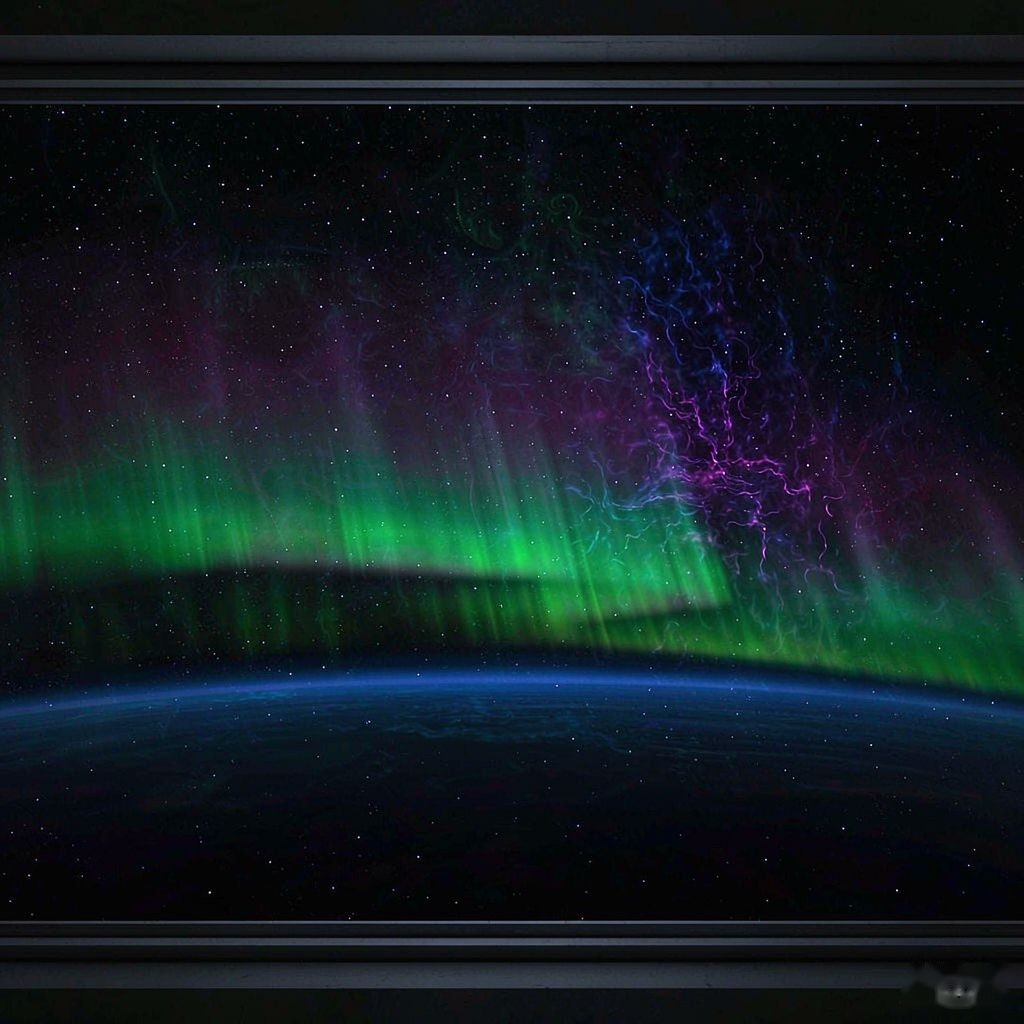
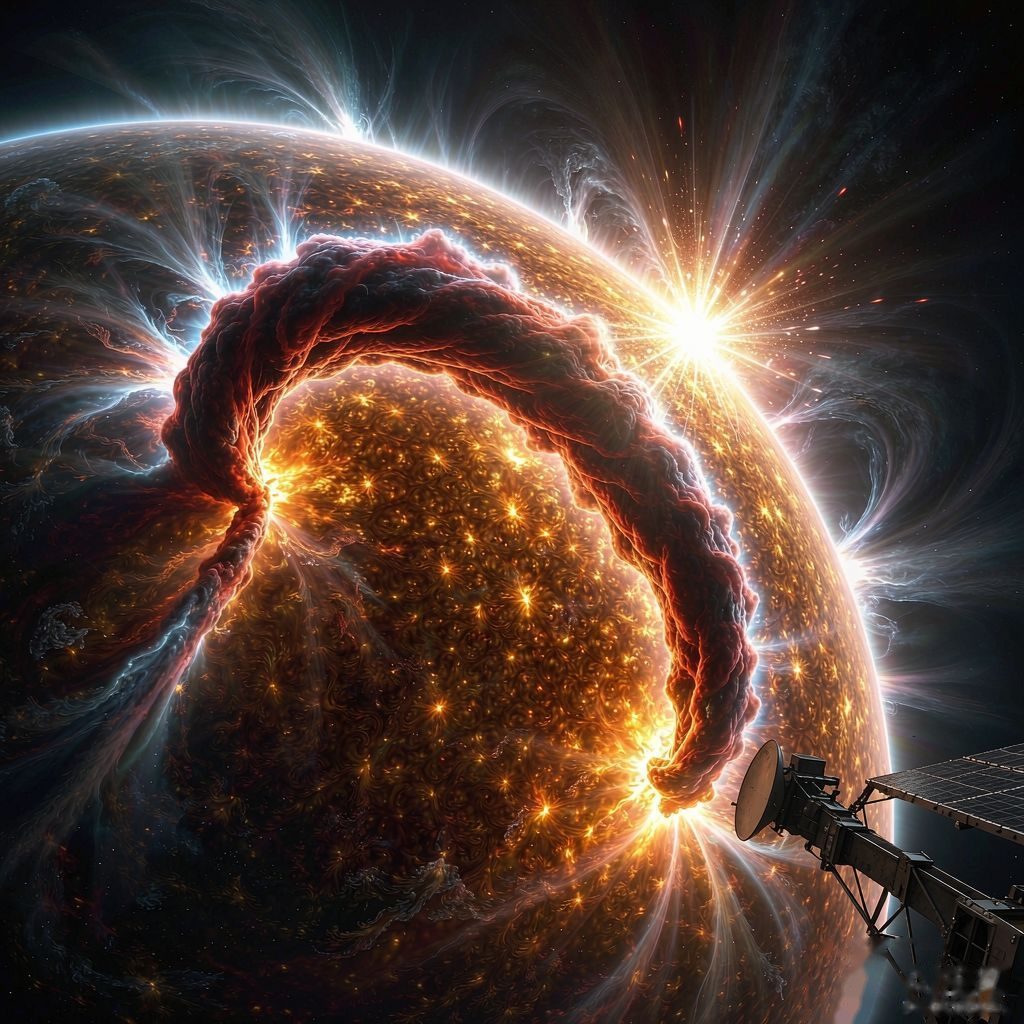
Auroras are the visual conversation between Sun and Earth. Charged particles in the solar wind, guided by our magnetic field, strike oxygen and nitrogen in the upper atmosphere, lighting them green, red, and violet. Solar activity cycles about every 11 years; at maximum, flares and coronal mass ejections can threaten power grids, satellites, and aviation — the 1859 Carrington Event set telegraph offices sparking. Watching auroras is beautiful; forecasting space weather has become vital infrastructure.
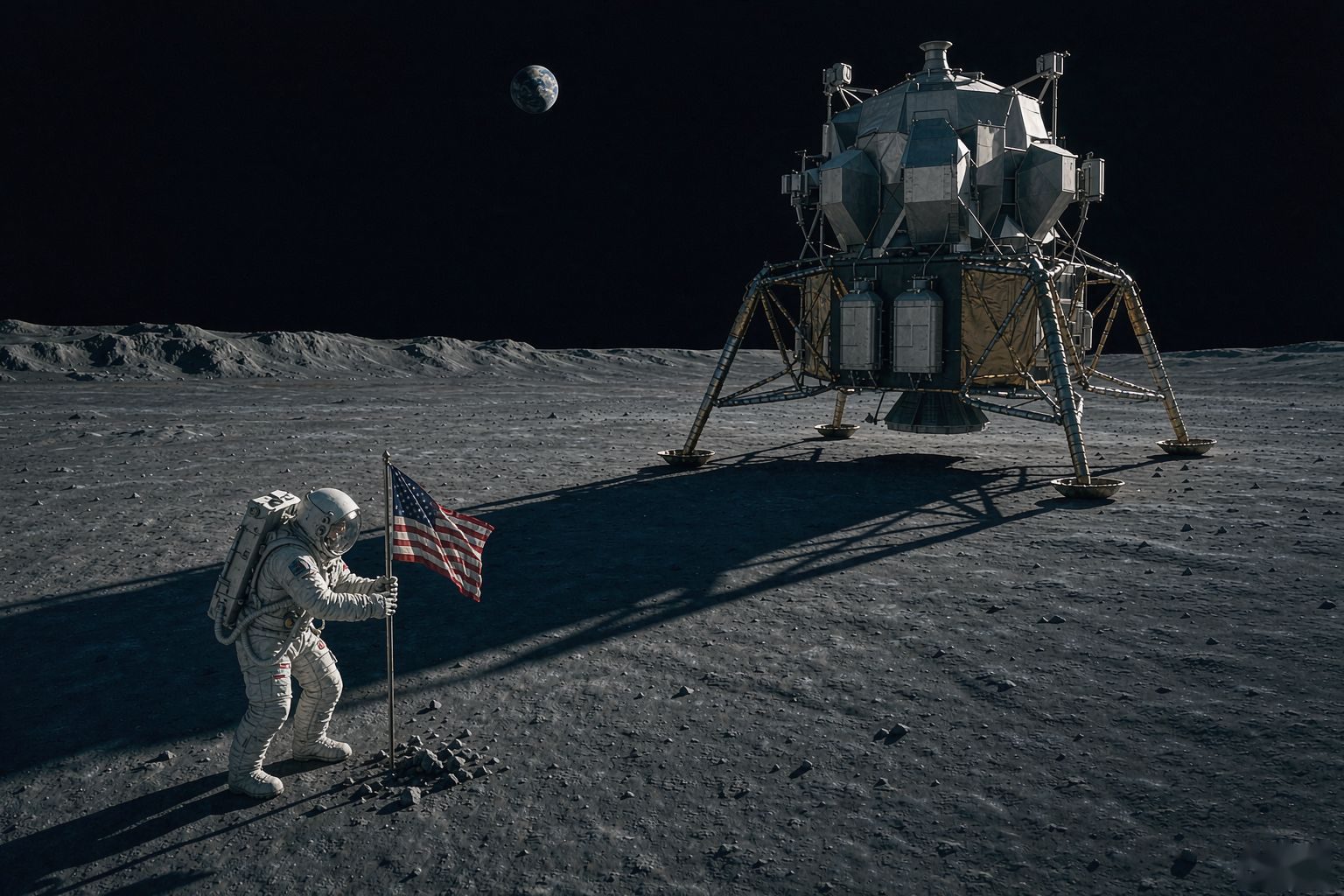
The Moon, Earth's only natural satellite, orbits 384,400 km away — light needs 1.3 seconds, Apollo took three days. Its diameter is a quarter of Earth's, an unusually large ratio; the leading theory says a Mars-sized body struck the young Earth 4.5 billion years ago and the debris coalesced into the Moon.
With no atmosphere, no liquid water, and no magnetic field, lunar temperatures swing from +127°C to −173°C under constant micrometeorite rain — but with no weather, Armstrong's footprints will outlast nations. The Moon rotates and revolves in the same 27.3 days, so one face always points toward us; the far side stayed hidden until spacecraft flew behind. Moonlight, of course, is reflected sunlight, and the phases are simply a calendar written in geometry — new moon between Earth and Sun, full moon on the far side of us.
For future exploration the Moon is being rediscovered: three days from home, it is the proving ground for deep-space habitation and ISRU; its polar ice and regolith oxygen are building materials; its weak gravity a cheap springboard to the rest of the solar system. To read the Moon is to read the first page of humanity's exit from the cradle.
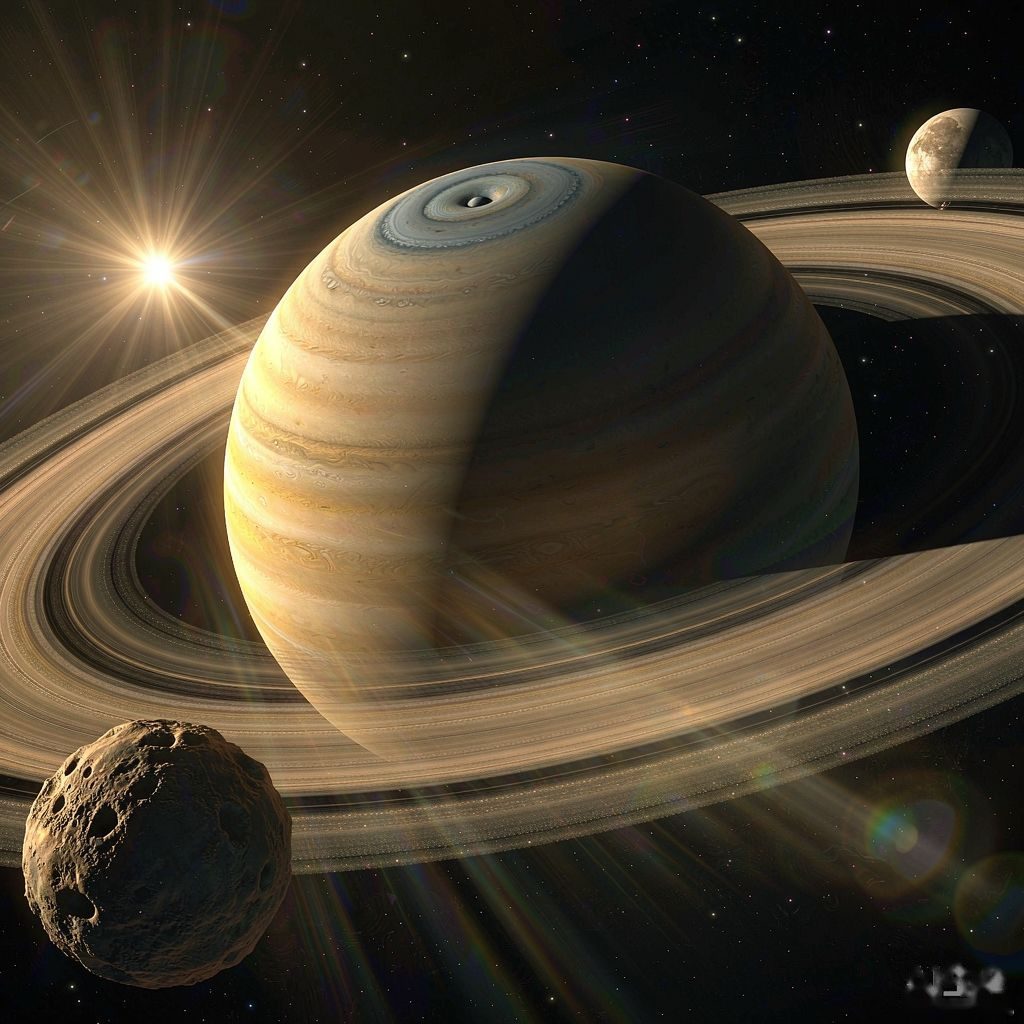
The eight planets split into two families: rocky terrestrials inside, gas and ice giants outside. Jupiter and Saturn are mostly hydrogen and helium — nearly solar in composition; with a bit more mass they might have ignited as stars. Jupiter has no surface to stand on: descending, gas compresses into an ocean of metallic hydrogen under pressures millions of times ours. The Great Red Spot is a storm at least three centuries old, wide enough to swallow two or three Earths.
Saturn's rings are the solar system's most famous spectacle — and surprisingly humble: trillions of ice chunks, from dust grains to house-sized boulders, arranged in a disc some 270,000 km across yet averaging barely ten meters thick — proportionally thinner than a sheet of paper. The debris may be a shredded moon or material that never formed one. Jupiter, Uranus, and Neptune have rings too, faint until stellar occultations revealed them in 1977. Cassini's final data suggest the rings may be younger than the dinosaurs — and are raining away so slowly that future astronomers may know them only from pictures.
At the ISS's altitude Earth's gravity is still ~90% of surface strength. Astronauts float because the station and everything in it are in continuous free fall around the planet — like an elevator drop that never ends. It's called microgravity, not zero gravity.
Starlight is bent by atmospheric turbulence, flickering point by point. Planets are tiny discs, not points, so the flicker averages out — a handy trick for telling them apart by eye.
The observable universe is ~46.5 billion light-years in radius (space expanded while the oldest light traveled). Beyond that, the universe almost certainly continues; we cannot know whether it is finite.
Yes — unloaded spinal discs relax and astronauts gain 3–5 cm in orbit, shrinking back on return. The cost: 1–2% bone mass lost per month, hence daily exercise.
It's a distance: how far light travels in a year, about 9.46 trillion km. Proxima Centauri is 4.24 light-years away — tonight its light left the star four years ago.
No rush: the Sun is midlife with ~5 billion stable years ahead before swelling into a red giant. Whatever humanity faces then, we'll have had time to prepare. The urgent question today is the stewardship of our own planet.
